Access Insights · Case Study
Keep Hawking Talking
From one user to everyone. Our chairman of the board and partner Pete Denman led the user interface design of ACAT (Assistive Context Aware Toolkit), the software Intel designed for Stephen Hawking so he could keep speaking as his abilities changed. It was released to the world as free open source software. And after Stephen died, Pete kept leading its design for another seven years, rebuilding it for everyone else who needs a voice, with new technologies and features and a redesigned interface.
Intel's official film on the collaboration with Professor Stephen Hawking. The interface it shows is the one Pete Denman led the design of. Watch on YouTube
"Medicine has not been able to cure me, so I rely on technology to help me communicate and live."
- Role
Design lead, Stephen Hawking's interface and the decade that followed
- Organization
Intel Corporation, Intel Labs
- Timeline
2011 to 2025, one user to a platform
- Legacy
Free open source software for augmentative and alternative communication (AAC)
- Research with Stephen
- Public debut 2014
- Open source 2015
- Beyond Stephen 2018
- Redesigned for everyone 2025
Act one · 2011 to 2016
One user. One muscle. The whole world listening.
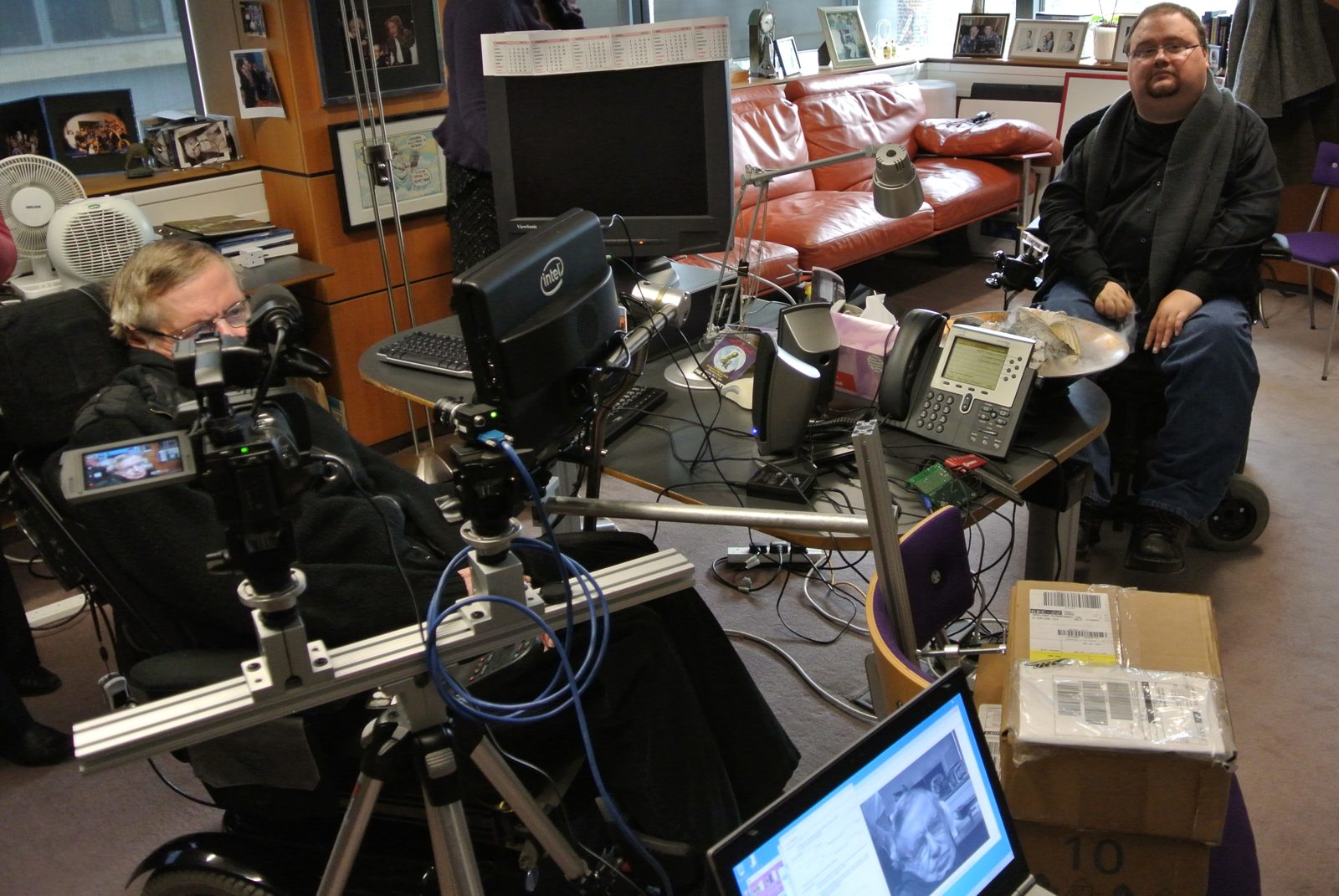
By 2011, ALS (amyotrophic lateral sclerosis) had left Stephen Hawking with limited movement. He could still use other muscles, but the one he could control most reliably was in his cheek, so his system was built around it: a twitch, read by an infrared sensor on his glasses. With it he ran a communication system whose core interaction dated to the 1980s, character by scanned character, and by then his rate had fallen to about one word per minute. Lectures, email, books, and every spoken sentence went through that one switch.
He asked Intel for help, and Intel asked Pete to lead the interface design. The brief was a paradox: make the system radically faster for a user with one input, without taking away an interface that was, after three decades, part of how he thought. The voice was not negotiable. The habits were not negotiable. The output had to change anyway.
Approach and build
Study the user, not the technology
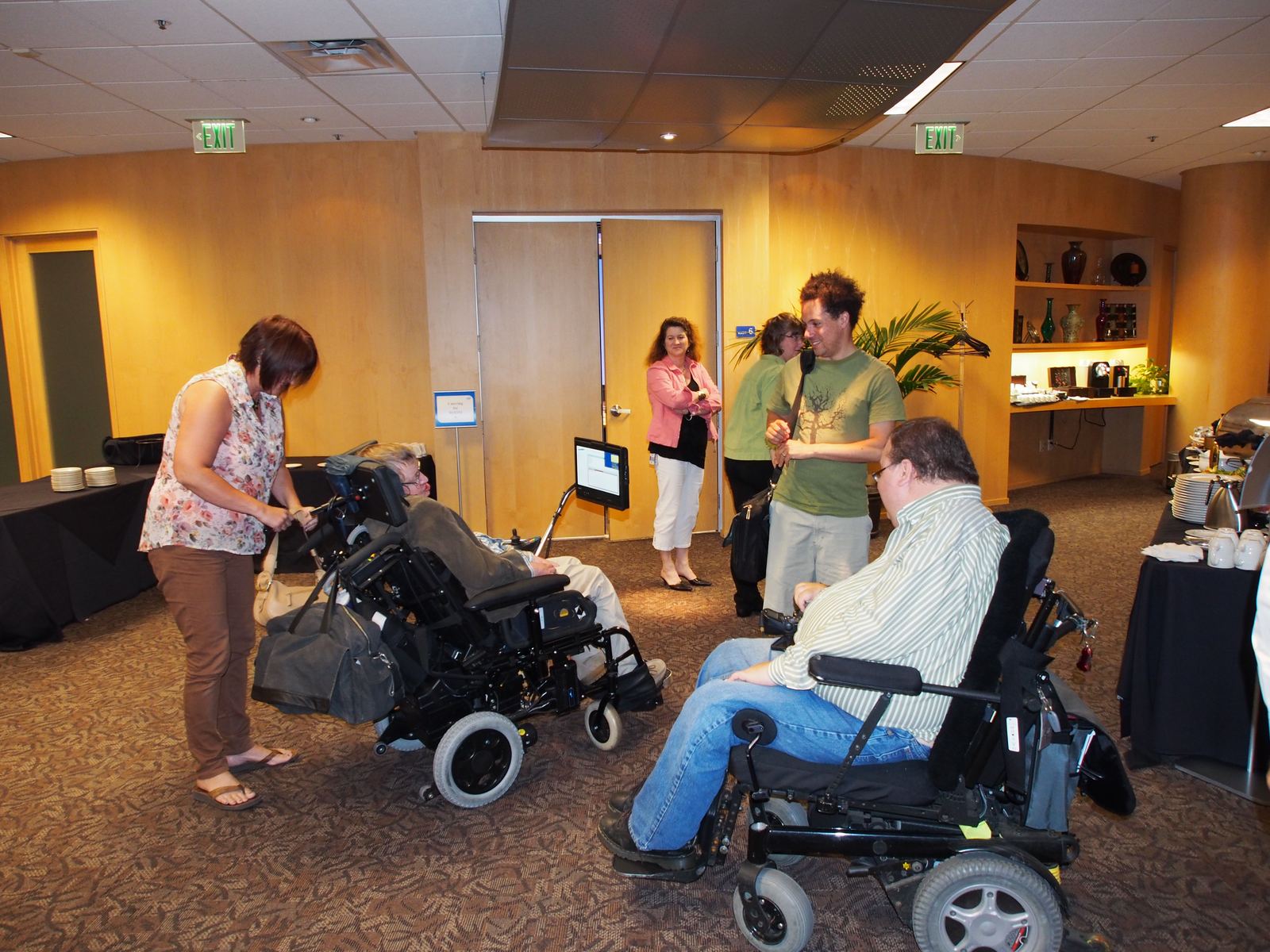
This was participatory design: Stephen was not a test subject, he was a codesigner. The team spent years in the work, visiting him at his Cambridge office and home, watching how he actually used the system rather than how anyone assumed he did. Some of the most useful insights were small ones found along the way. Watching video of Stephen straining his eyes to the left and right, Pete realized the world's most famous physicist had no way to see behind his own chair, and in about 2013 gave him a small mirror mounted on the monitor. The biggest design decision of all was restraint. Stephen had lived inside his interface for decades, so the team deliberately kept what he saw familiar, holding him within the affordances he knew, while the technology underneath changed completely • observe closely • preserve what the user trusts • let his reaction, not the roadmap, decide what ships.
A toolkit, not a gadget
ACAT wrapped the whole computer around that one switch: keyboard simulation with next word prediction, so he needed to type only about a fifth of the characters before the system could complete his thought, plus context aware menus that collapsed chores of up to fifteen steps into five or fewer • talking • lectures • email and files • browsing. At its public debut in December 2014, Intel reported that common tasks such as navigating the web, email, and documents ran about ten times faster. The input stayed exactly where Stephen wanted it: his cheek, his rhythm, his voice.
The release
Built for one. Given to everyone.
The ACAT mark, cut out of the background.
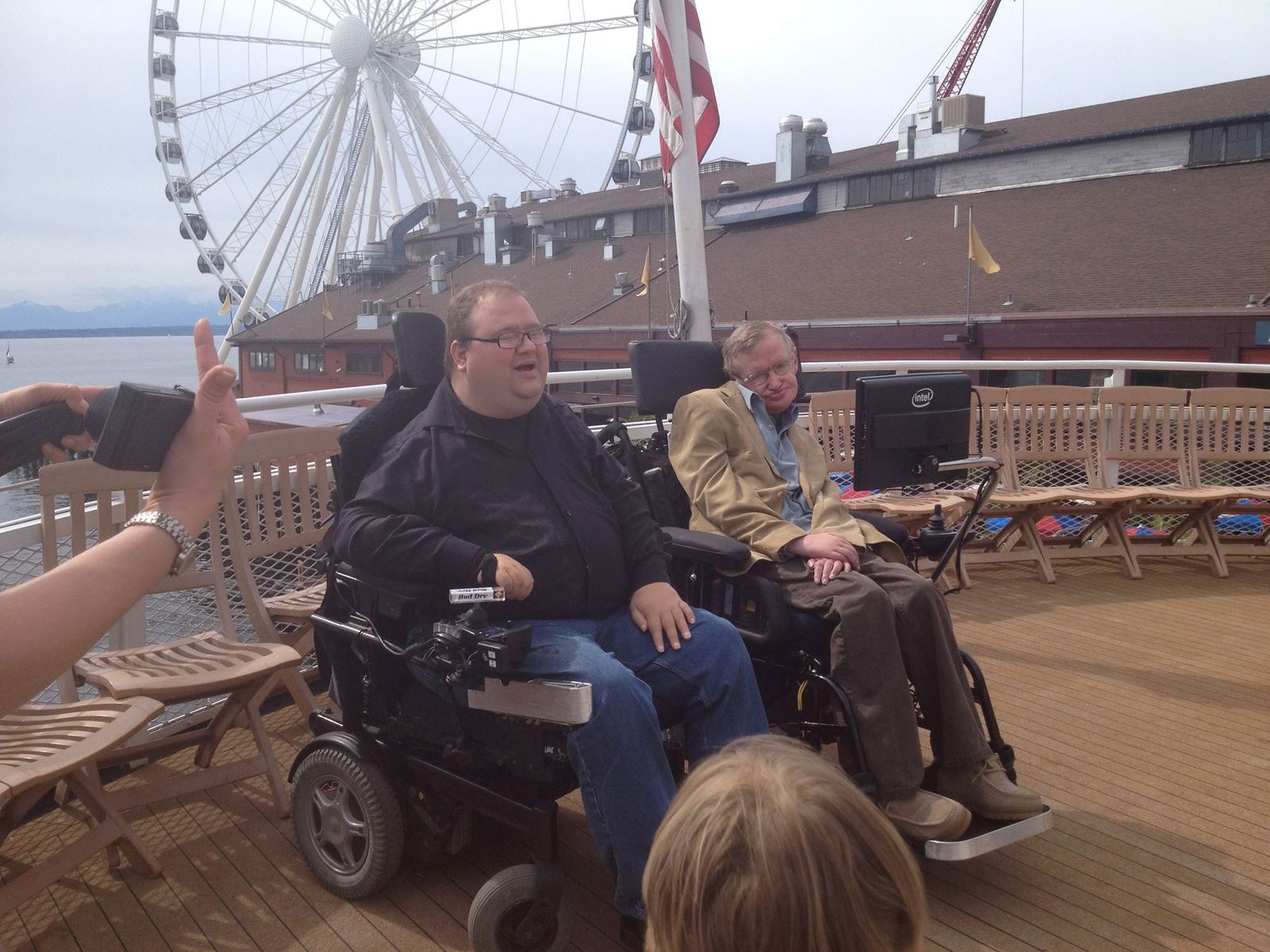
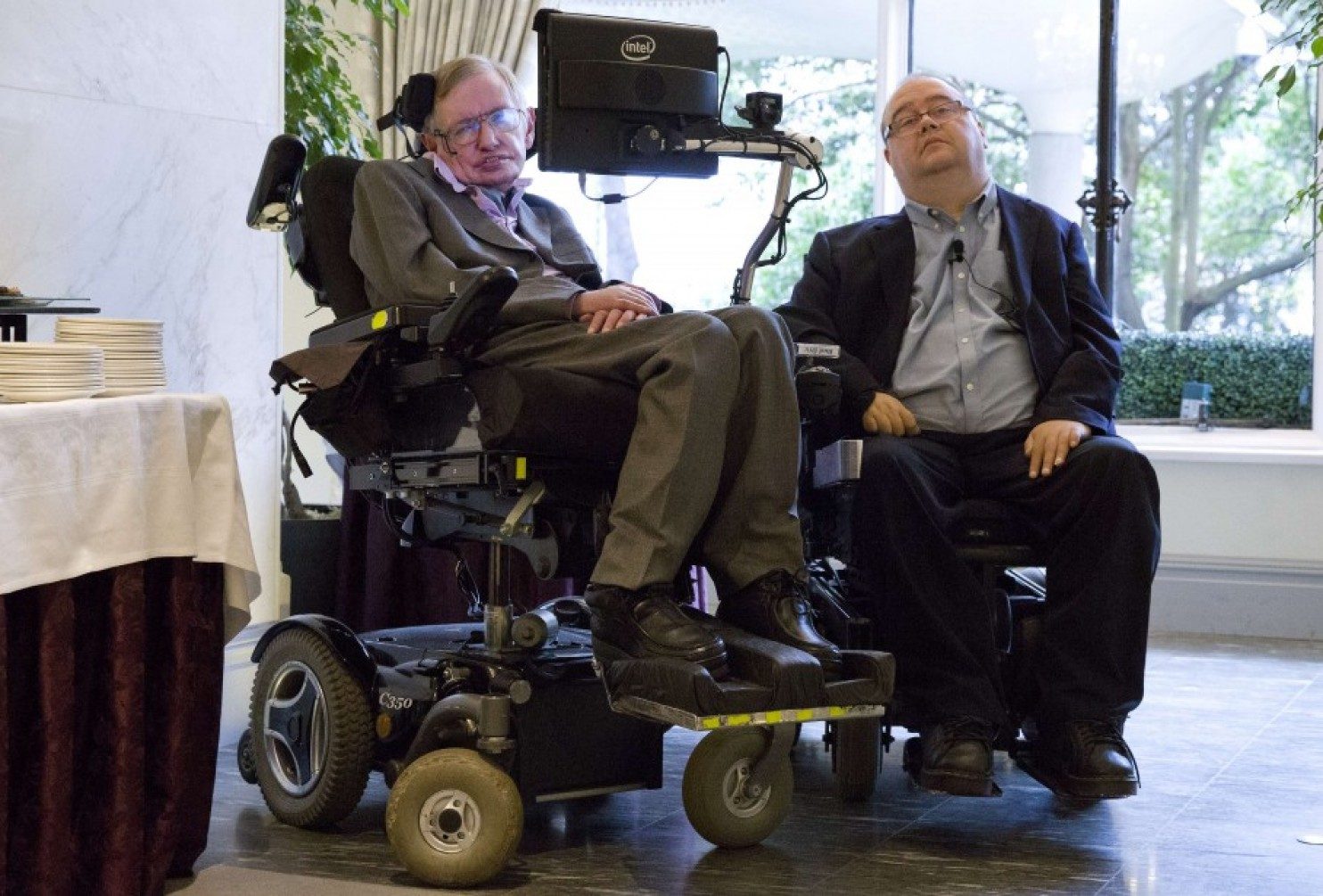
The system debuted publicly in London in December 2014, with Stephen Hawking on stage describing what it gave back to him. Intel put a number on the ambition: the same platform could be adapted for millions of people living with motor neuron disease and quadriplegia.
Open source was a cause Pete and Stephen championed together, and in August 2015 Intel released ACAT as free software, so that developers, researchers, and families could take the system built for the most famous disabled man on earth and fit it to anyone. That decision, made while the project was still about one person, is the reason there is a second act at all.
The hinge · 2018
Most projects built for one person die with that person.
Stephen Hawking died in March 2018. This project did not die with him. The open source release had already put the software beyond any single user, and the team that had spent seven years learning how one man communicated now had something it had never had before: permission to change what the user sees.
Every restraint that had protected Stephen, the familiar layout, the decades of muscle memory, the refusal to move anything he relied on, was a constraint the next generation of users had never asked for. The second act begins there.
Act two · 2018 to 2025
Redesigning for everyone who was not Stephen.
Pete led the design of that rebuild through 2025. The work was presented publicly with the Intel Labs team at Intel ON in 2023, under a plainer title than the one the press used: bridging the communication gap for motor neuron disease users with AI and BCI (brain computer interface). Underneath the title, four things changed.
Setup a family can finish
Stephen had a research team. Everyone else has a loved one with a laptop on a Saturday afternoon. So the redesign put guided onboarding at the front of the product: welcome, choose an input, map it, test it, done in one sitting. Separate flows for switch, camera, and brain interface, each specified down to type sizes and dimensions, because a system a family cannot set up is a system the user never gets.
Three different ways to say something
One interface could not serve every kind of talking, so the redesign split it into modes, each tuned by its own language model, and rebuilt the information architecture around them • Sentence for building a thought quickly • Short hand for fast exchanges with people who know you • Canned phrases for the things you say every day, kept one selection deep.
Keeping pace with a live conversation
The hardest thing a user of augmentative and alternative communication (AAC) does is group conversation: by the time a reply is typed, the room has moved on. Listen and Respond follows the conversation and drafts replies in context, with controls to steer keyword and tone rather than accept whatever is offered first. Five documented design iterations went into getting it right. The user still chooses every word that gets spoken.
A brain as the input
For users approaching a locked in state, with no reliable voluntary movement left, ACAT added noninvasive EEG (electroencephalography) as simply another switch. A personalized classifier reads the brain's response to a highlighted letter and fuses that signal with the language model's own next letter prediction, so two uncertain sources of evidence add up to one reliable selection. Nothing implanted, low cost hardware, and the interface on the other side does not change.
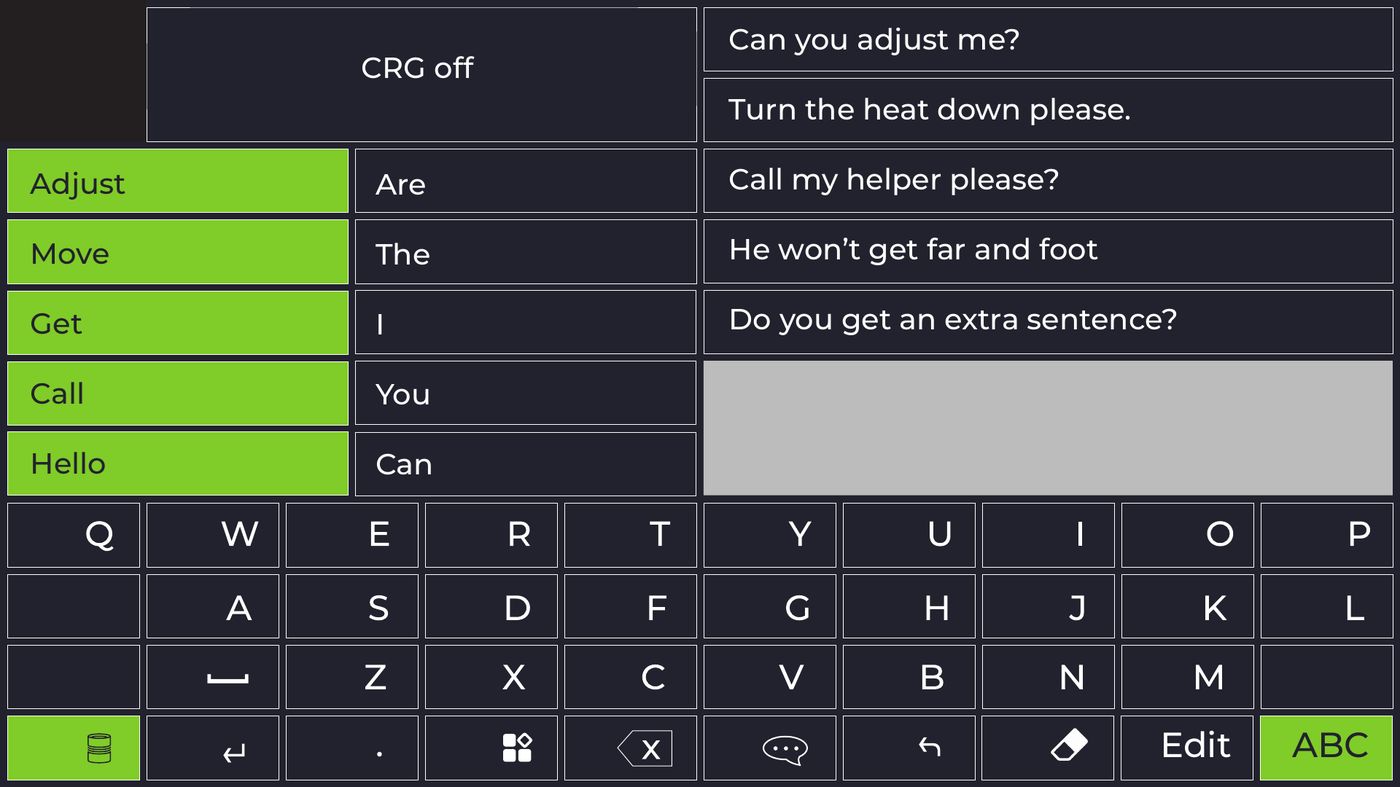
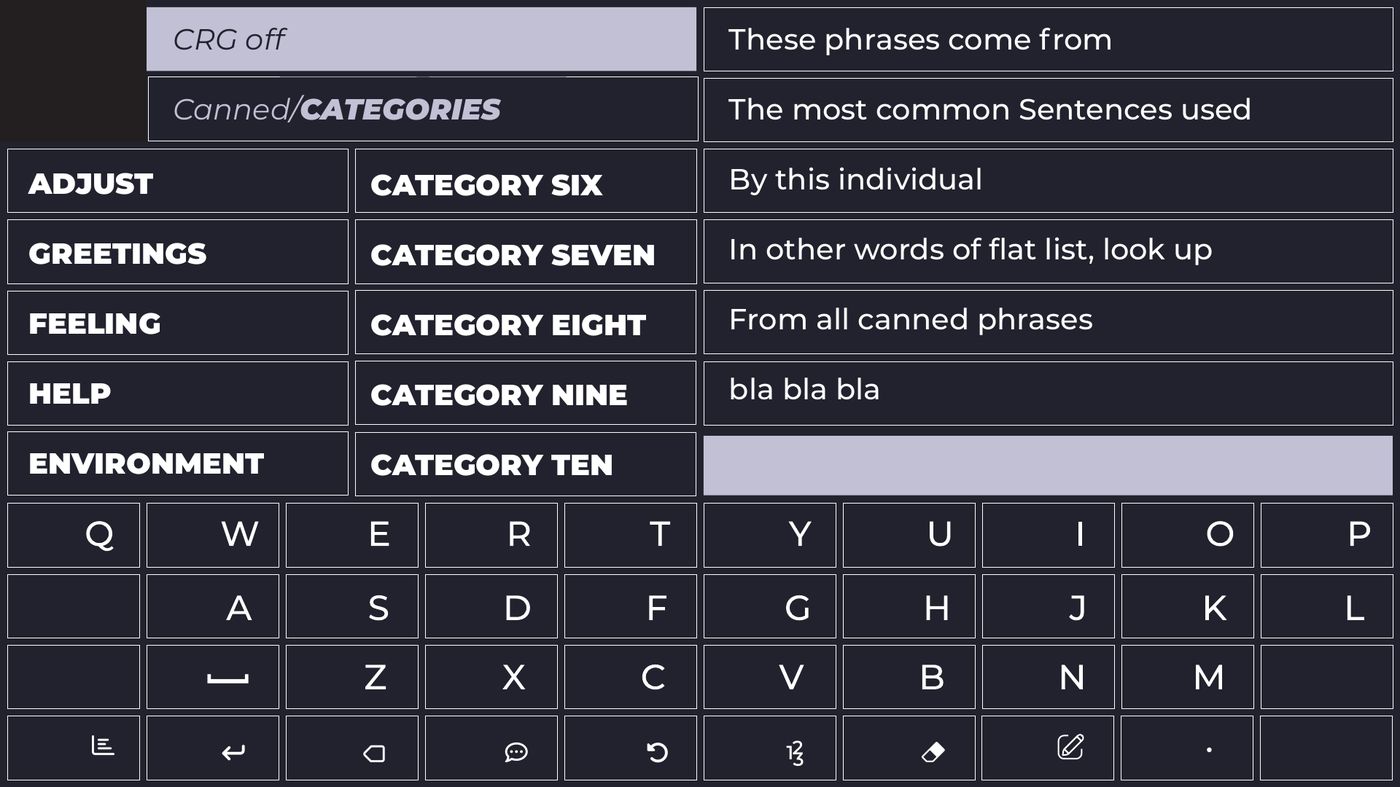
Intel's film on this release, "Assistive Computing: AI Response Generation and Brain-Computer Interface" (November 2023). Watch on intel.com
One switch in, a whole life out
The signal
- cheek movement
- eyebrow raise
- blink
- finger movement
- sip and puff
- any assistive switch
- EEG brain interface
The intelligence
- switch scanning
- next word prediction
- sentence prediction
- contextual responses
- context aware menus
The life
- speech
- lectures
- email and documents
- browsing
- the whole computer
Effort down, expression up
Every layer exists to spend the user's scarcest resource, effort, on meaning instead of mechanics: fewer than a fifth of characters typed, chores collapsed into single selections.
The user decides what it says. Always.
- their words, never autopilot
- their timing, never a prompt rushed
- their voice, kept for decades
Drawn from the shipped system and its published documentation. The input list grew over a decade, from Stephen's infrared cheek sensor to camera gestures and EEG, without the user ever having to relearn the interface on the other side.
The research
Then it was tested by people who were not on the team.
Formal usability research in 2023 put the new flows in front of real participants under a written protocol. The findings were unglamorous and useful: startup behavior that people read as a malfunction, icons that did not hold up at the size they shipped at, a camera input that needed a button fallback for the days a face will not cooperate. Each one was cheaper to fix in a study than in someone's living room.
Then the study returned something nobody had designed for. People with aphasia, a language impairment rather than a motor one, found a use for a tool built for motor neuron disease. That was not on any roadmap. It came from putting the work in front of the community and listening to what they did with it.
Study findings here are anonymized. Participant records, consent forms, and contact material stay in the project archive and are never published.
The use case scenario
What a decade adds up to, for one ordinary person.
Both acts land in the same place: a person who is losing their speech, and a system that has to still fit them three years from now. "Ana" is a composite built from the populations the research documented, motor neuron disease, stroke, brain injury, and the family members who set the systems up. Her arc is the argument for a toolkit rather than a product.
- Month 0
The diagnosis
Ana is 58 when ALS is confirmed, the bulbar kind that takes speech first. The clinic's timeline is blunt: most people like her lose functional speech within about three years. Her voice is her classroom, her phone calls with her mother, her jokes. The question is not whether she will need another way to talk. It is whether that way will still sound like her.
- Month 2
Setup, by someone who loves her
Her daughter downloads ACAT for free on a Saturday. The onboarding is built for exactly this person: a motivated relative, not a technician, walking through welcome, input selection, and testing in one sitting. The research behind it watched real families do this and fixed what confused them, because a system a family cannot set up is a system the user never gets.
- Month 3
Finding her switch
While Ana still has strong hands, a simple button works. They test the alternatives anyway: the webcam that reads an eyebrow raise, the proximity sensor that reads a cheek, the same family of triggers Stephen used. Any of them can drive the whole system, so the switch can follow her body instead of her body chasing the switch.
- Month 6
The first fluent sentence
Scanning highlights groups of letters; her switch picks one; prediction does the rest. She types a handful of characters and the system offers the sentence she was reaching for. The synthesized voice speaks it to the kitchen. It is not her old voice. It is unmistakably her sentence, at a speed a conversation can survive.
- Month 10
Keeping up at the dinner table
Group conversation is the hardest thing an AAC user does: by the time a reply is typed, the topic has moved. Listen and Respond follows the conversation and drafts likely replies in context, and she steers the tone rather than taking the first offer. Ana lands a reply, and a joke, while it still counts. Five documented design iterations went into getting that right.
- Month 14
The phrase bank
The sentences she says every day live one selection deep: greetings, care instructions, the exact words for how her body feels, and the sharp remarks she refuses to give up. Categories keep them findable. A voice is not only new sentences. It is the old ones, ready when she wants them.
- Year 3
When the body changes again
The button goes first, then the reliable cheek movement. ACAT's answer is the reason it is a toolkit: for users approaching a locked in state, it supports noninvasive EEG (electroencephalography) brain computer interfaces as simply another switch. The interface she has spent three years mastering stays. Only the trigger changes.
- Always
What no feature replaces
Every design decision serves the same rule the Cambridge visits taught: the user's words, the user's timing, the user's identity. ACAT never speaks for Ana. It clears the path between what she means and what the room hears, and her family gets her, not a transcript of her.
What this case proves
Lived experience is a research method.
Design for one user, done honestly, turns out to be design for many. ACAT followed the arc Access Insights now exists to run deliberately: begin with the community's lived experience, involve the people affected as codesigners, turn insight into evidence and working software, validate it with real users, and give the result a pathway into the world. Here the pathway was open source, and the validation continued for a decade. It is the same arc our Connected Wheelchair case study follows.
For Pete, none of this was abstract. A quadriplegic designer who navigates the world from a power chair, he was chosen to lead the work in part because he understood, bodily, what it means to depend on technology that must not fail you. He has called being dyslexic one of the most powerful things he has going for him: a mind that reads systems sideways found the mirror on the monitor, and everything that followed.
The result was a communication system trusted with one of the most valuable voices of our time, then handed to everyone who needs one. That happened because disabled expertise held design authority from the first Cambridge visit to the last release. We are building the infrastructure to make that the rule rather than the exception.
Fund a study, co-develop a prototype, or validate an emerging technology.
hello@accessinsights.net
Sources: the project's conference posters and program materials, including the 2023 Intel ON poster on AI and BCI for motor neuron disease users; Intel's December 2014 press release and Scientific American's report on it; public press coverage of the 2015 open source release; Intel's published profile of Pete Denman; and ACAT documentation and research materials, with study findings anonymized.